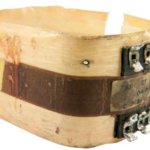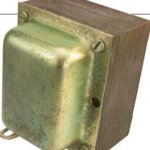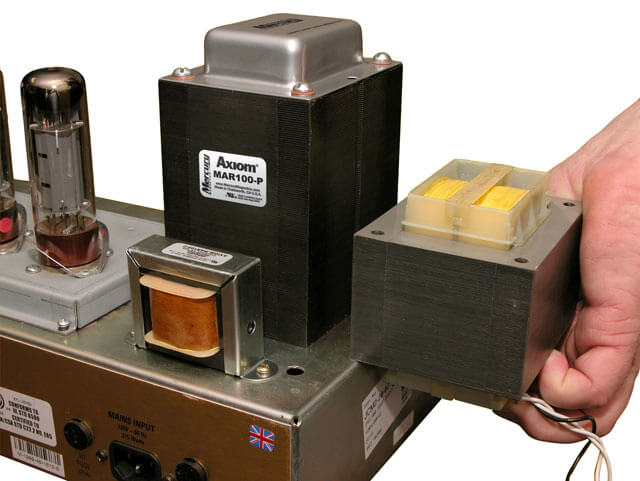


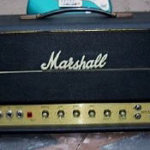
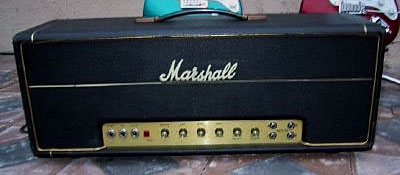
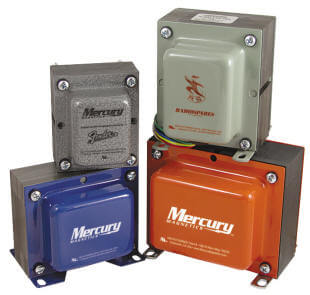
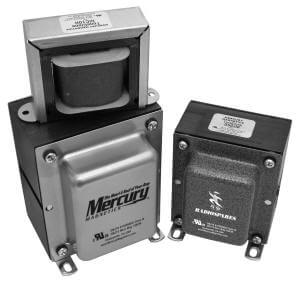
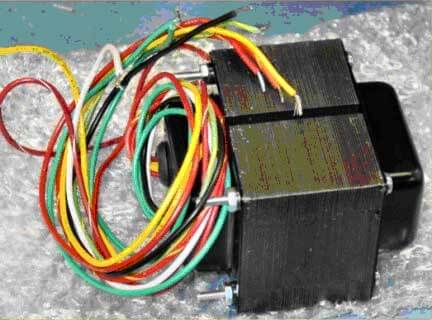
 Mercury Magnetics™ offers three choices for replacement 50 watt output transformers and I had the opportunity to try two of them. The units are part of the Axiom® or ToneClone™ series which are hand-built replicas of the original transformers used in the Marshalls of various eras. In addition to the Marshall replacement transformers, Mercury Magnetics™ also makes various other Axiom® models for classic Vox and Fender amplifiers in addition to other toneful amps such as Ampeg, Gibson, Hiwatt, and many others.
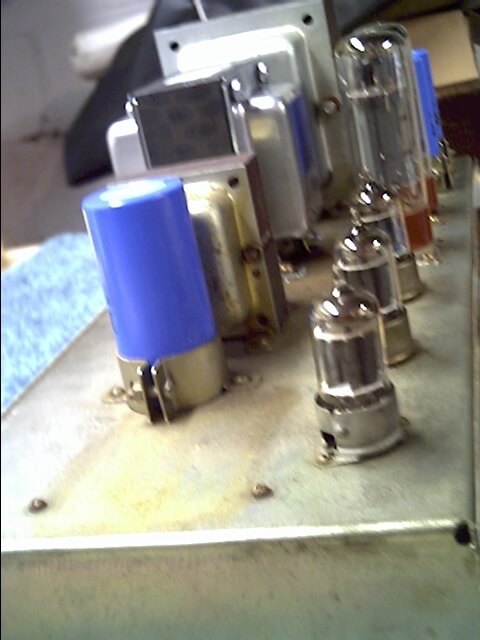 Moving over to the O50JM, I was amazed at how different this transformer sounded, even though other than the lead wires that exited the transformer, it has the same specifications and parts as used in the O50JM-SL! After installing it, I knew that the O50JM was the choice for the hard-rockers, whether using a plexi or metal panel-front Marshall. The O50JM had more distortion dirt and grind in the tone. Both transformers contributed to a very smooth response from the Marshall, but the O50JM traded off the upper frequency and some of the clarity content found in the SL model for what sonically resulted to its increased distortion and compression.
 300guitars: Why should guitar players care so much about the transformers in their amps?
 300guitars: How does the power transformer affect the sound of your guitar? The sound comes from the output transformer right?
 300guitars: When it comes to transformers does size matter? How?
Boy have I got a treat for you guys!!! As you know I am a big fan of Mercury Magnetics transformers and have been a dealer for many years now. Their products are excellent as well as their customer service. The Mercury Magnetics line is quite extensive and they will do custom pieces as well.
I have been working with Sergio Hamernik for almost a year now on an exclusive interview all about guitar amp transformers. In this interview Sergio talks about how transformers affect your amp’s sound and feel, if transformer size matters and how it affects tone, what a choke is and much more information.
Mercury Magnetics is the leader in guitar amplifier transformer manufacturing. I have personally used their iron in many repairs, restorations and custom builds over the years. It never ceases to amaze me when I use a set and listen to the amp after the project is complete. It’s almost like a blanket was taken off of the sound and you are listening with “3D glasses.” The feel of the amplifier becomes much more dynamic as well. In my opinion “your amp’s transformers truly are the heart and soul of your amp.”
In this exclusive interview with Sergio Hamernik (the man behind the scenes at Mercury) some basic questions that all relate to the tone and feel of a guitar amplifier. His answers are forward, straight to the point and insightful.
300guitars: Why should guitar players care so much about the transformers in their amps?
Sergio Hamernik: When a player has to struggle with his amp then there’s really not much of a reason to play it. The tonal quality and performance of a tube-type guitar amp is largely determined by its transformers. Where there is great “tube tone,” you’ll always find “great sounding transformers” making it all happen!
Once you get past the player’s talent/ability, it’s all about the tone. If an amp doesn’t produce desirable tone, the window of inspiration closes and gets replaced with fatigue for both the player and the listener.
These days musicians who choose to play an electric guitar are only as good as their technical awareness and development allows them to be.
Transformers are the most important and most expensive components of guitar amp’s parts list. Also, they are the only components designed and built specifically for that amp, unlike the rest of the components — the resistors, capacitors and even vacuum tubes. These other components are considered to be “universal application” parts — meaning not just for making guitar amp tone. The electronics industry commonly uses these same components for medical, industrial, radio and many other applications. You certainly couldn’t fit or use guitar amp transformers for any of these other applications without offending someone.
Transformers are the key to providing that unique signature tone. It’s the transformers that differentiate one amp brand or sound from another. Here’s another way to look at it — all amp builders have to deal with the same limited choices from a small pool of vacuum tube manufacturers and other off-the-shelf component requirements (resistors, capacitors, etc.). This is NOT so with the transformers. Although there are plenty of generic transformer designs available that service the “power requirements” of an amp, you wouldn’t want to use these awful-sounding devices in your guitar amps. Likewise it’s not a coincidence that most of the best-sounding amp builders, modifiers, and repair techs begin their craft and finish it with enviable distinction, relying on their choice of transformers.
300guitars: Would you explain, in guitar player terms, what power and output transformers are?
Sergio Hamernik: Well, I really don’t like to lump all guitar players into one category. Making assumptions here (be it charitable or not) just doesn’t seem fair to me. Each player has their own level of interest and technical understanding on this subject. So I’ll split my answer into three different groups of definitions and let the player choose the one that suits them best.
In basic guitar player terms: It’s magic!!
In technician terms: A device applying mutual inductance in an efficient manner, so that circuits with different voltage/current requirements can correspond to each other.
In engineering terms: Transformers are electrical devices consisting of a magnetic-core and two or more coils (commonly referred to as windings) inductively coupled as circuits for the transmission of alternating-current energy from one closely coupled coil to another usually at a different voltage and current value. Transformers are also used for matching impedances between the signal generating source and the load.
300guitars: How does the power transformer affect the sound of your guitar? The sound comes from the output transformer right?
Sergio Hamernik: Yes the amplifier’s sound does come out of the output transformer, but where does it all begin? While an output transformer is vital to an amp’s ultimate tone, it simply can’t do it alone. The power transformer is the first step in building tone and in setting the standard of performance that the tubes and output transformer utilizes.
The output transformer depends on the power transformer for determining the maximum amount of power the amp can put out. The power transformer is also a major contributor for the overall feel of the amp. Such as punch through (the oomph factor), note attack, a perceived larger/wider soundstage presence and most importantly, the speed or reaction time of the amp’s audible response to the player’s sense of touch and playing technique. Tamper with that in any way by using cheap “dumbed down” power transformers and your audience may confuse your amp’s tone with the sound that is made by farting into a pillow!
A puny power transformer will deliver puny tone no matter how good the output transformer is. A good output transformer is also not intended to be a problem fixer or a turd-polisher. Garbage in is always garbage out. So please don’t shoot the messenger because the power tranny just ain’t cutting it.
Output and power transformers are actually close cousins. Doing similar tasks, one matches and isolates the speaker from the amp and the other one matches and isolates the amp from the power company. Peace keepers of a sort, preventing tubes from frying the speakers and preventing the power company’s energy from frying the amp and people connected to it.
300guitars: How does the output transformer affect the amps sound and feel?
Sergio Hamernik: An output transformer is the last component of the audio chain. The amplifier’s voice. The final word that reaches the speaker. Because all vacuum tubes were never really designed to distort intentionally, the weight of producing desirable amplified guitar tone falls heavily on the transformers. The output transformer’s job is to coax, extract and even irritate the power tubes into tone-friendly distortion. Ever wonder why solid-state amps have always played second fiddle to tube amp tone? Is that simply because of not employing tubes or of not having an output transformer? At the very least, it’s something to think about.
The output transformer determines how the amp sounds like from fully clean (sweet with a touch of sparkle) to fully over-driven (chainsaw) distortion, and everything in-between.
By the way, the term “clean” as used in guitar amp speak is a bit of a misnomer. There is no such thing as a distortion-free guitar amp. “Clean” simply refers to less distortion. There is an intimate inductive/reactive relationship between the output transformer (coils) and the speaker voice (coils) that also back-washes into the power tubes and influences that “clean to dirty” range of distortion. The quality of the output transformer determines how well the production of tone is executed by the amp — those notes that float between the strings which are created by overtones, chimes, bell tones, sustain, etc. Poorly made output transformers tend to gargle out, squash and mask those overtones.
The output transformer is also responsible for how efficiently the audio power of the amp transfers to the speaker (load). Ultimately, the player issues the final report card for the performance of the amp and the output transformer with comments like “clarity,” “articulation,” “loudness,” “break-up,” “grit,” “glassy,” “grind,” “dirty,” “woody,” “mushy,” “mashed,” “fuzzy,” “dark,” “cloudy,” and so on. There are hundreds of guitar amp speak descriptions and euphemisms out there which capture their emotional response (players and listeners alike) to what is coming out the amplifier’s window.
The mighty output transformer. Loved and hated by so many. Still one of the most misunderstood components of a guitar amp. 80 years and going strong. Go figure….
300guitars: When it comes to transformers does size matter? How?
Sergio Hamernik: I can almost hear my wife saying “now that sounds like a guy question.” Actually, in most situations, transformers and chokes make a good case for “bigger is better.”
A power transformer that is undersized for the job will run hotter than a bitch kitty. The amp is unable to be pushed — collapsing under weak, sagging voltages. It’s unable to keep up with the demands a player puts to an amp. The amp slows and has a tendency to cough out notes when played clean, and honk or bark out the notes when overdriven.
Another symptom of undersized and/or poorly designed power transformers is the phenomenon of “tone drift.” You know this is happening when the amp (common with some early Fenders and half of today’s 100 watt amps) starts off with decent tone for the first hour or so, then somewhere around two hours later the tone begins to change and not for the better. The internal temperatures of the transformer reach their peak and begin detuning the voltages and power the amp sees. This is caused by the changes to the resistance of copper. As the temperatures become excessive, the amp’s tone drifts. Remember rich amplifier tone needs to be well fed.
An undersized output transformer will act more like a suppository to amplified guitar tone than a big open window, which is its main purpose. Contrary to popular myth, there is no tone magic that occurs when you force feed an output transformer into alleged saturation or intentionally under power it with a dinky power transformer.
The term “output transformer saturation distortion” comes out of poor guessing by people who really don’t understand how tubes and transformers work together to produce music friendly harmonic distortion. If an output transformer reaches true saturation, all bass frequencies will disappear, the mid-range will sound dark and fuzzy with lower volume — leaving the treble frequencies tinny and brittle sounding. Does that sound desirable to you?
So it’s not the transformer itself generating that saturation effect on overdriven guitar tone. Good output transformers are designed to operate at low flux densities (loads of inductance). That low flux makes it difficult to saturate an output transformer. So the output transformer doesn’t get the credit or blame for that “saturated” sound. The actual source is in the push-pull power tube plate circuit reacting/saturating to the changing impedance it sees in the primary coil of the output transformer as its flux density changes with the changing frequencies and fluctuating power coming into it. The saturation phenomena (when it appears) is mostly happening in the tube.
If one wants to intentionally use a dinky power transformer to achieve tone magic (yes some have tried it, believe it or not). They could save themselves a bunch of money and buy that pillow I mentioned earlier for similar results.
Bigger is better for chokes if you have the room for it on the chassis. Assuming the same value of inductance, more iron and copper will let more power through and it will run cooler as well. This is because of lower DC voltage resistance with the extra copper involved. More voltage being available to the tubes means more power out of the amp.
300guitars: What is the choke for and why do you offer so many models?
Sergio Hamernik: Originally chokes were used in guitar amps to extend the life of vacuum tube rectifiers nearly tripling their life expectancy. They behave as a quasi current spike shock absorber. Chokes help capacitors smooth out any ripple that may be present on the DC voltage. The goal here is to always try to get the cleanest voltage to the tube circuits. Caps by themselves do a pretty job of it. But the choke is a multi-tasker. Along with doing a nifty job of smoothing out ripple, the choke does something else that makes it a significant contributor to the amp’s final tonal character. Because its connected in series with the rectifier and not tethered to ground like a cap, the choke (being an inductor) works nicely as a current regulator. And it keeps the current from decreasing as much as it would if there were only caps involved.
This nearly constant current available from the power supply, courtesy of the choke, makes for an ideal platform to make the best possible tone. Simply put, changing the value of the choke changes the tone and behavior of your amp.
Why so many varieties of chokes? Since chokes are a significant link in the audio chain, a one size fits all approach would be a great injustice to all guitar amp owners. Choke values are a finesse point, a fine tuning that helps to extract the most favorable tonal characteristics from an amp. We even offer a “shift on the fly” option with our multiple-value Multi-Chokes. One choke with several choices of inductance to help the amp builder find that sweet spot.
There is one last benefit to using chokes and it’s the most overlooked attribute. When a choke is connected between a couple of caps, a form of a low pass filter is created. What this means is the choke blocks high frequency garbage on the AC line from mixing with the guitar signal and causing all sorts of sonic collisions during the process of amplification. Let us not forget that we live in an electronic age far more complicated than the 1950s or 1960s. There are all sorts of things contaminating our power before it hits our amps. Computers, TVs, BTL cable services superimposed on our power lines, you name it, are all sources of noise we don’t want in our amps.
You’d be surprised to find out how many amp builders substitute a resistor for a choke just to save a few bucks and lose out on the choke’s very cool advantages. Almost all of the great vintage amps had chokes (Marshall 50 & 100 watt, Vox AC30, Fender Twin, Showman, Super Reverb, Vibroverb, Pro Reverb, Deluxe Reverb, etc.). The builders back then were taught tube theory and understood the relevance of the choke in their designs.
300guitars: Would a Mercury replacement reverb transformer make the reverb in an amp sound better?
Sergio Hamernik: That depends on how lousy the original one was. Reverb transformers are wound similar to guitar pickups. Lots of turns with very thin wire. Which adds to the expense of building them. Many companies skimp on materials to keep their costs down as a result.
We believe that the low level signal (barely a whisper) going into the reverb transformer is quite fragile in nature and anything less than using the best materials and winding techniques would cause it and its tone harm. According to our customers that have upgraded their reverb transformers with ours, they report better performance, higher def, a more lush-sounding reverb, etc. Based on that, my answer is yes — or your money back.
300guitars: Is it easy to upgrade an amplifier to a set of Mercury transformers?
Sergio Hamernik: Heck no! It’s not at all easy. Therein lies the rub. This is why we have the great divide between disappointing “corporate” tone and a thriving (yet inconsistent) boutique amp market.
How much hassle and expense are you willing to put up with to get your ideal tone? If merely swapping out tubes will improve tone, then why are we still missing so much of it today? If simply plugging things in or out made for better tone, then all the big amp companies would have nailed it decades ago and we wouldn’t have the need for this interview. But no, it’s not that easy. Quick, cheap and dirty (non-transformer) amp fixes are not worthwhile timesavers. They tend to act more like tinsel and don’t do much for real tone problems. My wise old grand dad once said, “Putting powdered sugar on a turd, doesn’t make it a doughnut.”
Upgrading to Mercury transformers requires technical expertise and a morbid fear of being electrocuted. There are potentially lethal voltages present, a ship load of wires coming out of these things to further complicate matters and requiring a good share of installation elbow grease to boot. A person should be schooled in electronics and not sexually frustrated. A steady hand goes a long way in doing a good install. It shouldn’t be a D.I.Y. project no matter how simple it may look to the casual observer. We have techs all over the planet that are willing to help and do a good job with safety first. Transformers are expensive and labor intensive to install.
Those who are ready to make such a commitment/sacrifice (who needs kids anyhow?) will be rewarded for their efforts. Don’t take my word for it, just read our testimonials. We have a bunch of them all unsolicited from players, amp builders and amp techs, who were impressed enough to write to us telling everyone that it was well worth it.
300guitars: It seems that tubes and big hunks of iron (transformers) are very old school technology. Is there anything new on the horizon at Mercury?
Sergio Hamernik: Playing a guitar is even older school. There isn’t anything modern about an electric guitar. But, what makes an electric guitar “electric” is the fact that it depends on the rules of magnetism. The pickups on an electric guitar are made of coils of wire responding/reacting to a changing magnetic field, so are the voice coils in speakers. And let us not forget the power transformer, choke and output transformer in an amplifier are doing their jobs through magnetic fields — literally completing the link between a player’s finger tips to the player’s and listener’s ears.
My point being that if you replace your amp’s transformers for something else, you might as well replace the electric guitar with something else. So happily, we’ll stay stuck with big hunks of iron and hang on to our electromagnetic guitars! This means that tubes, which are not magnetic devices, could eventually be replaced by other devices such as high-voltage Field Effect Transistors as long as they’re mated to right kind of transformers. This is stuff that you don’t really need to know, but it’s a point of interest. There are a lot of motivated people out there that are fed up with the poor quality of tubes today and might be able to make tube substitution a reality someday soon I hope.
What’s new on the horizon at Mercury? A bunch of stuff. A cool new line of transformers that will give the next generation of players a unique voice of their own. Vintage is great, but we also want to encourage a new generation of inspired song writers and players to continue guitar based music. It’s all about the tone that will help seed this.
We are in the process of designing, developing new Upgrade Kits, pre-packaged transformer sets for those who are not satisfied with the tone of their present day amps. It’s our passion.
And, possible amp tone clinics. If that is what players want. We are also working on things that are a bit beyond the horizon which I’ll talk about sometime later.
300guitars: Thanks Sergio for taking the time for this most informative interview!!!
Sergio Hamernik: Thanks Billy for this interview and for giving a damn about all this stuff we call tone. Your passion clearly shines through on your website. It’s people like you that keep it all going and compel us to continually raise the bar for the guitar playing community.
I also want to apologize in advance if I offended anyone’s sensibilities with any comments I may have made. I will learn to live with the guilt….


 Doesn’t that predate the Nocaster?
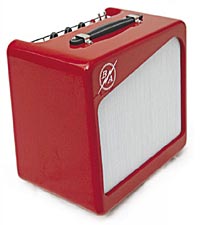 Did you get to play that original Tele that was copied for this run of instruments?
 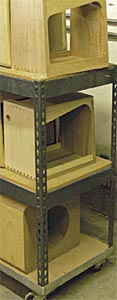 So what you had was three or four amps, all without names or model numbers which were essentially prototypes
 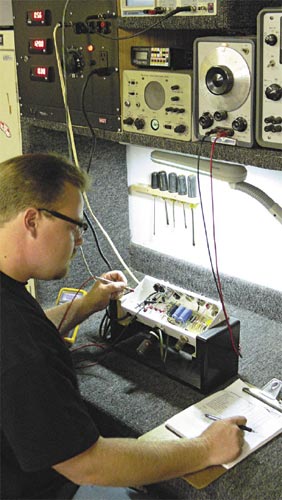 So, I’m looking at it, and George leans over and says, “You know, you’re the first person who touched the inside of that amp since Leo; you’d better be careful!” Because no one had touched it in all those years, the chassis, being made of steel and zinc plated, was pretty much pure white and powdery — I wasn’t about to leave my fingerprints in it!
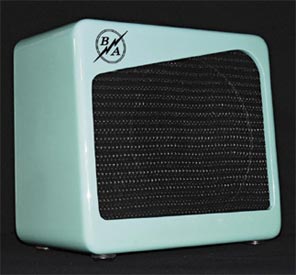 Over the years, guitars and their finishes have gotten more elaborate, but you aren’t doing that with the new Model 10; it is using simple shape, texture and color for the amplifier, rather than the busy style of many expensive guitars.
 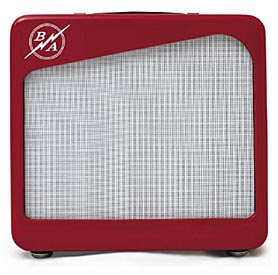 Is there a tube rectifier?
 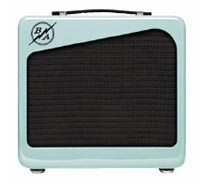 It’s exciting to see the founding of a company with such an amazing product. Do you have a price set for the Model 10?
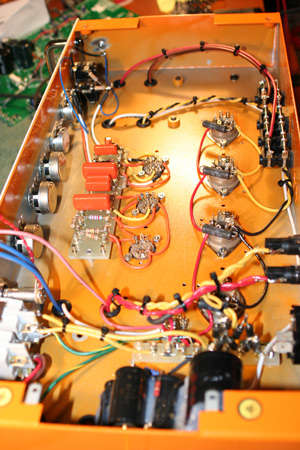
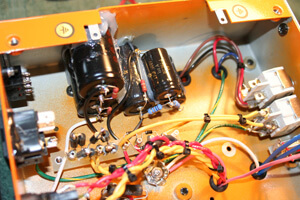
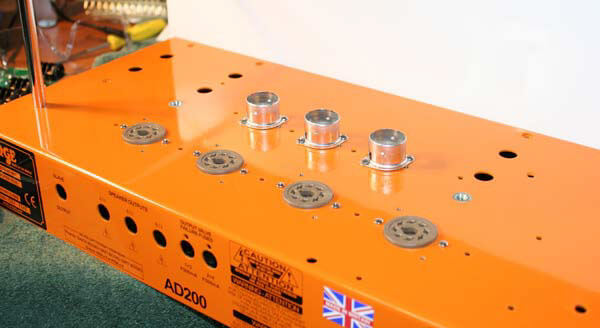
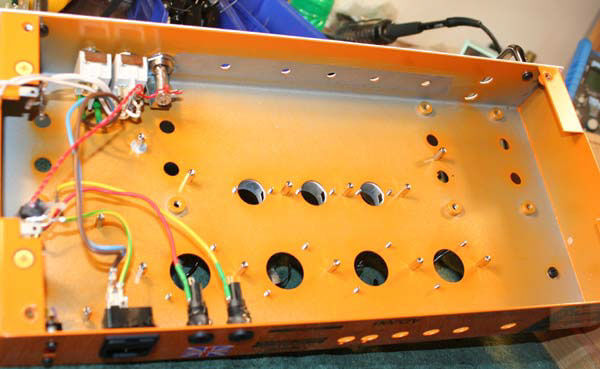
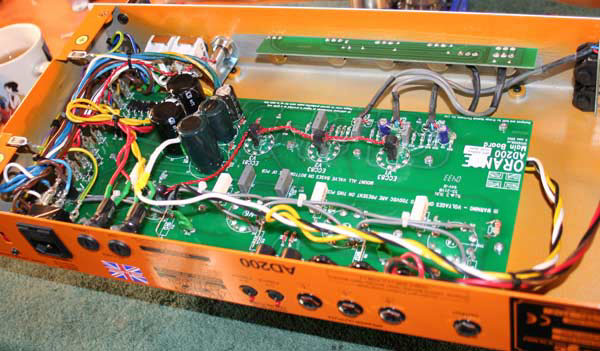
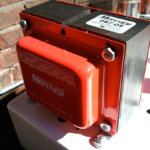
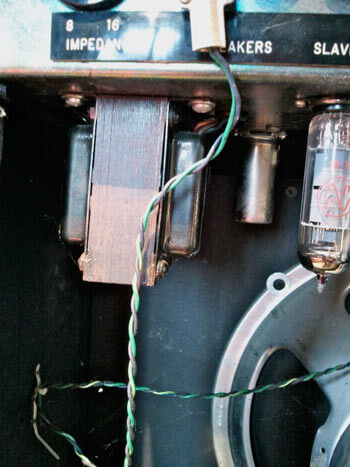 Secondly, be aware of the different mounting styles of transformers. There are three basic mounting styles: vertical, horizontal, and flat. Vertically mounted transformers sit taller than they are wide, with the laminates in a vertical position and the end bells positioned perpendicular to the chassis. Horizontally-mounted transformers are still a vertical mount, but are tipped on their sides and are wider than they are tall. Transformers that are mounted flat have the laminates facing horizontal, and the bell ends are stacked vertically. One should also note if the transformer is a two-hole or four-hole mount, and that the mounting holes will not line up exactly if the transformer you are replacing is not an exact replica. In such cases, it will be necessary to carefully mark and drill new mounting holes into the amp’s chassis.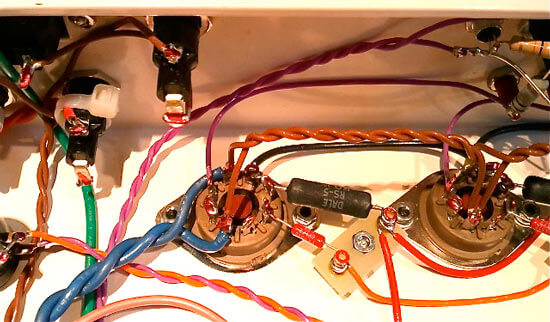
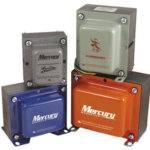
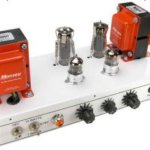
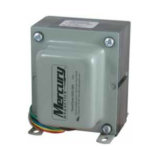

 Founded in the mid-1940s in Fullerton, California by Leo Fender, the legendary amps produced by this company have been heard on countless recordings and are influential on countless other amp makers. In the beginning Fender paired small combo amps with lap steels and electric guitars aimed at student players, but word of the superior tone and build quality quickly spread among professional musicians. In over seventy years of existence, Fender has consistently evolved and innovated its sound from the Tweed era through the Brown and Blackface eras and beyond.
 Fender Woodie Amp Transformers:
 amount of artists from all generations have crafted their distinct tone using these amps through all genres. Notable artists include: Scotty Moore (Elvis Presley), Neil Young, Larry Carlton, Eric Clapton and Keith Richards. Mercury Magnetics has the largest catalog of vintage-correct Fender ToneClone® replacements transformers for the following models:
  Fender Blackface Amp Transformers:

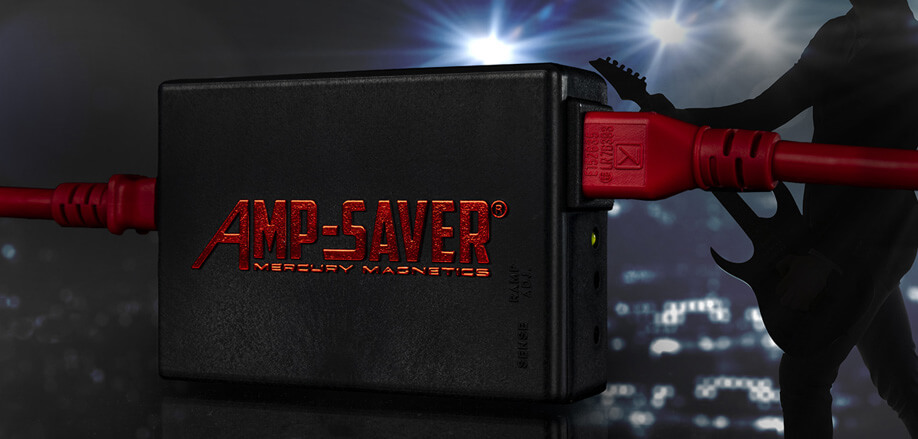

 Meanwhile, let’s address the common belief that 45 year old Vox amps are too unreliable — dangerous, even — for ecstatic thrashing, let alone regular gigging. While it is true that the design of the AC30 (and AC50) provide precious little ventilation (the top vents are stingy at best), we have seen AC30s used by touring musicians and there were no flames shooting from the back (Daniel Lanois didn’t even bother with a backup). So we asked ace amp tech Don Butler (
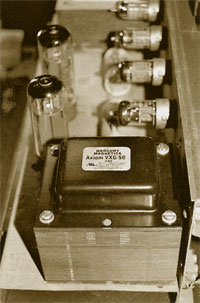 Check all your valves/tubes. Always use a matched set of EL-8rs and good 12ZX7s and a decent 12AU7. Spend the money for a good rectifier! You have to look at the cost of valves as an investment in your tone. Good preamp valves should last at least 10 years for NOS. I’ve seen many Ac30s with perfectly working Mullard GZ-34s that were 40+ years old. EL-84s get beat-up pretty good, but still important to buy quality valves. This is also important: With any and every JMI Vox Amp, use a Variac! Why? My wall voltage reads anywhere from 114v to 122v A.C. Vox amps want to see 105v to 110v MAX! The voltage selector may say 115v, but Sergio at
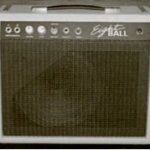
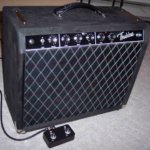
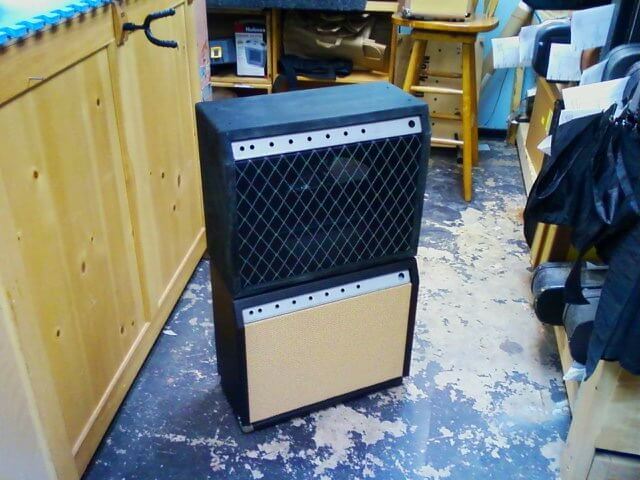
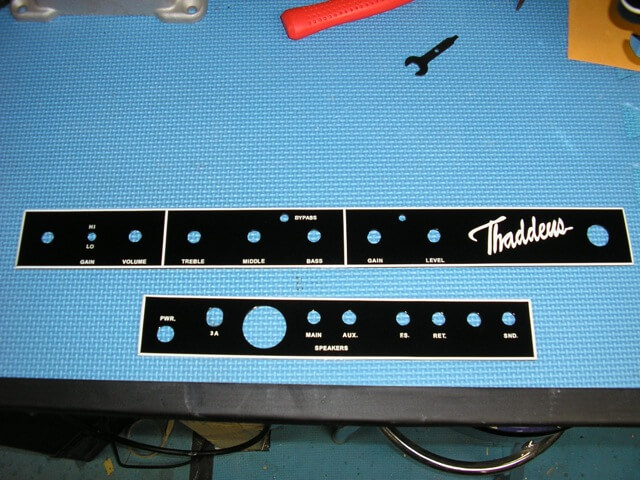
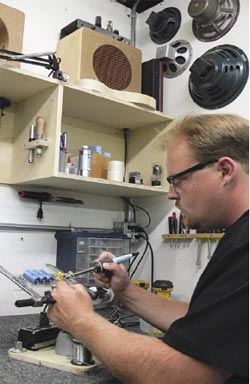
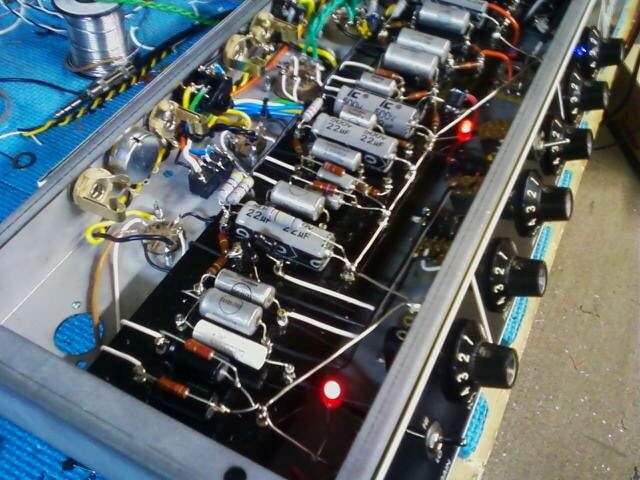 Rob builds every aspect of the amp. From the cabinet and grillcloth to the faceplate (painting and vinyl lettering)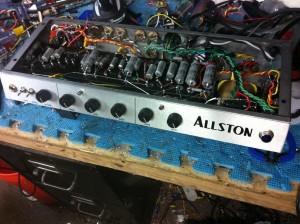



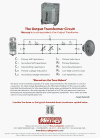 For vintage-style transformers, Mercury starts by duplicating the transformer design, build errors and all. We use the best grade components like they did in the ’50s and ’60s. We wind every layer and every turn as if it were a circuit in itself. In fact, the diagram on the left shows an output transformer circuit equivalent. Most people would think it is an audio circuit. These things are fairly complex, and all the numbers have to be right in order to get the tone we want as musicians.
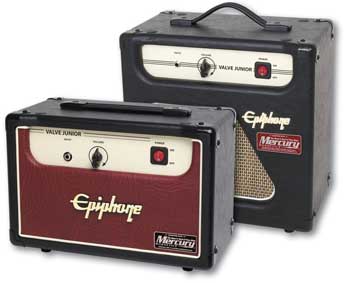 I designed all of the magnetics (the transformersandMini-Choke) and the general concept behind the Upgrade in league with Allen Cyr from the
 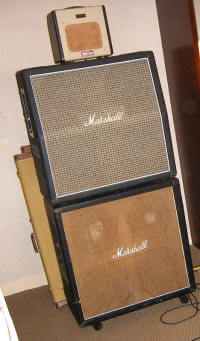 At the