
 The Category 5 Tempest and 1900 brew up a storm of blues and rock built for the gigging musician.
Category 5 is built on a partnership between Don Ritter and Steve Scott that began as a way to make amplifiers and raise money (and awareness) for charity at the same time. The focus was first on charities providing relief for natural disaster victims (of the Asian tsunami and hurricanes Katrina and Rita), thus the names of the company and its amplifiers. As it has grown, so has the scope of both the products and the philanthropy, which supports an expanding list of worthy causes from Feed the Children and Voice of the Wetlands to the “Blues in the Schools” program, and Blue Star Connection, which provides musical instruments to children with life-threatening illnesses.
This is worthy of mention not only because it exemplifies the principle that you do well by doing right, but also because Cat 5’s amplifiers demonstrate the virtues of doing it right from the get-go. The designs are built on the notion that it’s the players, not the builders, who should determine what qualities an amp has. The touring pros and other players Ritter and Scott set out to satisfy needed tough, overbuilt cabinets and chassis that could handle life on the road; they needed scalable power output to achieve the same tone from the same amp at the right volume for any venue; and they needed amps that would be easily coaxed into giving up outstanding tones. In other words, the design principle and the philanthropic principle are really the same principle: try to give people what they need.
Category 5 started by making waves on the blues scene, providing back line for several festivals (where they were often asked to sell their amps right off the stage), and in a short time they’ve gathered a truly impressive list of artists. The number of signature offerings and approved charities continues to increase. If it’s not a signature model you’re after, there are nine other models — including these two — to choose from.
They also offer a variety of cabinet configurations. The one that arrived with these amps was a large, angle front, closed back 2×12, made from eleven-ply Baltic birch. It is only a tad smaller than a standard 4×12, and it’s enough to handle almost every application. Its Celestion G12H Heritage speakers provided a surprisingly generous low end with depth and control for both amps.
Each Cat 5 amp comes with a goodie bag that includes a vinyl cover, a full set of extra tubes and fuses, and Analysis Plus oval speaker cables.
The Tempest
 In keeping with the convention, both of our review amps are named for storms. All of the models except the Tempest are named for historical storms; the Tempest, if you remember your Shakespeare, was a magical storm sent by Prospero to daze and confuse his rivals.
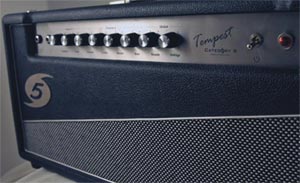
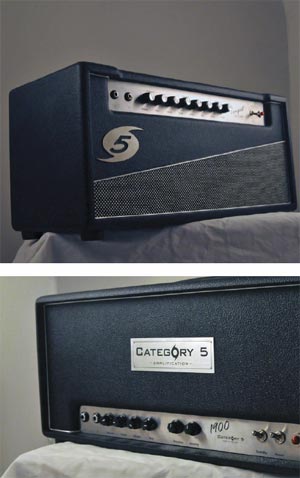
The 45-watt, cathode-biased, dual EL34-powered Tempest is a touch flashier than the 1900, with a big, hurricane-shaped “5” logo, vinyl covering and basket weave grille cloth separated by diagonal silver piping, and controls located at the top of the cabinet. Channel one has only a volume and a single Tone control, while channel two provides volume and 3-band EQ controls. Global fold back reverb, power scaling, and a single On/Off/Standby switch with neon indicator complete the control set.
The back panel has some more modern amp features, like an effects loop and a mid-boost switch for channel 2, a line out jack with line level control (you’ll need to run it through a simulated speaker load before going into a board), and footswitch control of the reverb and boost.
Plugging In
Instead of the usual “clean” and “dirty” channels, Cat 5’s dual-channel amps, like the Tempest, offer two different tonal signatures, both of which go from clean to crunch with just the combination of amp and guitar volume knobs. Power scaling makes the overall volume adjustable. The idea is to have two distinct amps in one head — in this case a JTM45-inspired channel one, and a Plexi-style voicing for channel two. Although they’re not completely different, they are distinct.
Using a few different test guitars, a Gibson LP Studio with Alnico V Burstbuckers, a Gibson LP BFG with a Zebra Burstbucker 3 in the bridge and P-90 in the neck, and my Fender Contemporary Telecaster with stock pickups, I found that channel one does the Marshall-like voicing, but somewhat softer. It has good response and excellent definition. With the volume up all the way, this channel has greater clarity and presence at the top end than channel two, as well as smoother distortion. It cuts very nicely, and can be coaxed into giving up the “Beano” tone with a good, transparent boost.
Channel 2 seems to have more headroom, and much more depth and body up through the mids, with a warmer sustain. To be honest, the big, beefy cleans and creamy top end make it a great blues amp, but channel two wasn’t as much of a thrill ride as I’d hoped, and the mid-boost switch didn’t seem to give it the kick it needed. Using the two Les Pauls, the crunch could’ve been tighter, and at high volume there was some loss of definition in the middle. I’m sure this wasn’t all the amp’s fault, as it seems to prefer vintage-style pickups with lower output. The Burstbucker 3 in particular bit in too hard, audibly reducing the dynamic range and smoothness.
For the final test, I used an A/B/Y box to jumper the two channels. Yowza! The best of both channels came through with energy and conviction. Easily the best tone in the box. The bridge pickup on my Tele did a terrific “icepick” tone on this setting, and the neck pickup was all creamy blues, but with more oomph than I’m used to hearing from it. Like the other Cat 5 amps, the Tempest uses high-quality components from companies like Analysis Plus, Mercury Magnetics, SoZo, Accutronics, etc. — you get the picture. This amp is going to be with you for a while.
As Tested $2995 — Category 5 — category5amps.com
Buy if…
you’re looking for a soulful, tone-heavy amp that’s tailor made for taking your blues on the road.
Skip if…
you’re not that into the blues… or the road.
Rating… 
Source: https://mercurymagnetics.com/pages/news/PremierGuitar/PremierG-13.htm


